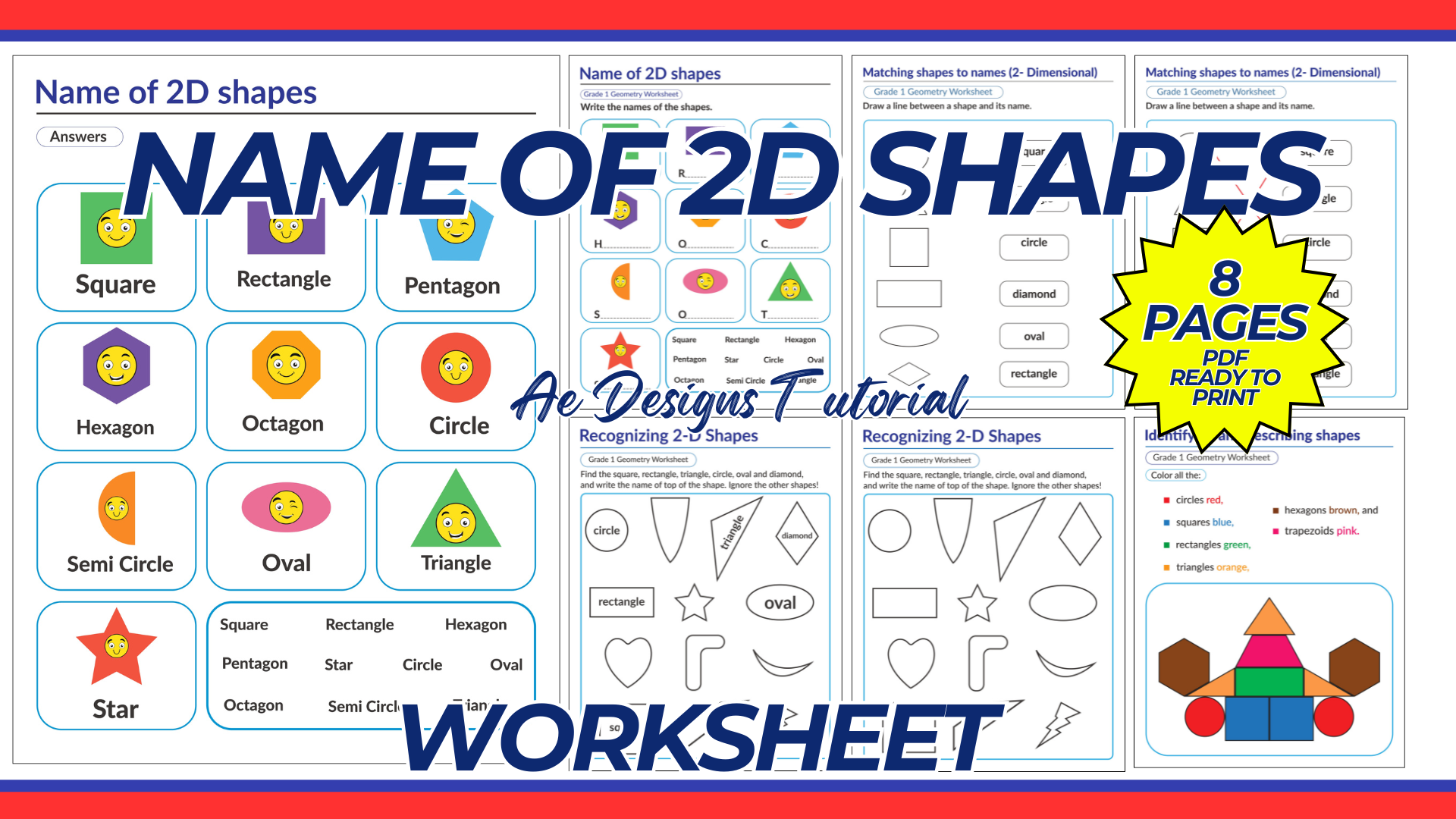

Learning the Names of 2D Shapes
Teaching children about 2D shapes is a fundamental aspect of early mathematics education. Understanding the properties and names of different shapes helps build a foundation for more advanced geometric concepts. Here’s a comprehensive guide to the names of 2D shapes, along with their properties and some engaging activities to help children learn.
1. Basic 2D Shapes
- Circle:
- Definition: A round shape with no corners or edges, and all points on the edge are equidistant from the center.
- Properties: One curved line, no corners.
- Examples: Coins, wheels, and clocks.
- Square:
- Definition: A shape with four equal sides and four right angles.
- Properties: Four equal sides, four right angles, opposite sides parallel.
- Examples: Chessboard squares, tiles, and picture frames.
- Rectangle:
- Definition: A shape with four sides and four right angles, with opposite sides equal.
- Properties: Four sides, four right angles, opposite sides equal and parallel.
- Examples: Books, doors, and windows.
- Triangle:
- Definition: A shape with three sides and three angles.
- Properties: Three sides, three angles (can be acute, obtuse, or right).
- Examples: Traffic signs, pyramids, and slices of pizza.
- Oval (Ellipse):
- Definition: A shape resembling a stretched circle.
- Properties: Curved lines, no corners.
- Examples: Eggs, mirrors, and racetracks.
- Rhombus:
- Definition: A shape with four equal sides but not necessarily right angles.
- Properties: Four equal sides, opposite angles equal, opposite sides parallel.
- Examples: Diamond shapes in playing cards and kite shapes.
- Parallelogram:
- Definition: A shape with opposite sides that are parallel and equal in length.
- Properties: Four sides, opposite sides equal and parallel, opposite angles equal.
- Examples: Slanted squares, and some architectural elements.
- Trapezoid (Trapezium in UK):
- Definition: A shape with one pair of parallel sides.
- Properties: Four sides, one pair of parallel sides.
- Examples: Tabletops, handbags, and certain bridges.
- Pentagon:
- Definition: A shape with five sides and five angles.
- Properties: Five sides, five angles.
- Examples: Home plate in baseball, and some road signs.
- Hexagon:
- Definition: A shape with six sides and six angles.
- Properties: Six sides, six angles.
- Examples: Honeycomb cells, and some nuts and bolts.
- Heptagon:
- Definition: A shape with seven sides and seven angles.
- Properties: Seven sides, seven angles.
- Examples: Some coin designs, and certain architectural structures.
- Octagon:
- Definition: A shape with eight sides and eight angles.
- Properties: Eight sides, eight angles.
- Examples: Stop signs, and some tabletop designs.
- Nonagon:
- Definition: A shape with nine sides and nine angles.
- Properties: Nine sides, nine angles.
- Examples: Some decorative elements, and certain coin shapes.
- Decagon:
- Definition: A shape with ten sides and ten angles.
- Properties: Ten sides, ten angles.
- Examples: Some board game tokens, and certain architectural features.
2. Teaching Strategies
- Visual Aids:
- Posters and Charts: Display posters and charts of 2D shapes in the classroom for visual reference.
- Flashcards: Use flashcards with images and names of shapes to reinforce recognition and memory.
- Hands-On Activities:
- Shape Sorting: Provide children with a variety of shapes to sort and categorize.
- Drawing and Coloring: Have children draw and color different shapes.
- Shape Hunt: Organize a shape hunt around the classroom or home where children look for and identify different shapes.
- Interactive Games:
- Shape Bingo: Create bingo cards with different shapes and call out the names for children to mark.
- Online Games: Utilize educational websites and apps that offer interactive shape games.
- Storytelling:
- Shape Stories: Create stories involving different shapes as characters. This can help children remember the shapes and their properties in a fun context.
- Building and Creating:
- Blocks and Construction Sets: Use building blocks and construction sets that feature different shapes.
- Art and Crafts: Engage in art projects where children use shapes to create pictures or models.
3. Reinforcement and Practice
- Daily Practice:
- Incorporate shapes into daily activities. For example, ask children to identify shapes in their surroundings regularly.
- Worksheets and Printables:
- Provide worksheets where children can practice drawing and identifying shapes.
- Shape of the Day:
- Focus on a “Shape of the Day” and explore everything about that shape, including its properties and real-life examples.
- Math Integration:
- Integrate shape recognition with other math concepts such as counting sides and angles, symmetry, and simple geometry.
4. Benefits of Learning 2D Shapes
- Cognitive Development:
- Learning about shapes helps develop critical thinking and problem-solving skills.
- It enhances spatial awareness and visual processing abilities.
- Foundation for Geometry:
- Understanding basic shapes is a crucial step towards learning more complex geometric concepts.
- Shapes are the building blocks for understanding patterns, symmetry, and other mathematical principles.
- Real-World Connections:
- Recognizing shapes helps children make sense of the world around them.
- It aids in everyday tasks such as reading maps, understanding signs, and organizing objects.
- Creativity and Art:
- Shapes are fundamental to art and design. Learning about them fosters creativity and artistic expression.
Conclusion
Teaching children the names and properties of 2D shapes is a vital part of their early education. Using a variety of strategies, including visual aids, hands-on activities, interactive games, and daily practice, can make learning shapes engaging and effective. Understanding these shapes not only lays the groundwork for more advanced mathematical concepts but also enhances cognitive development and creativity. By incorporating shapes into everyday learning and play, children can develop a solid foundation in geometry and a greater appreciation for the shapes that make up their world.
NOTE: Isa isahin nyo na lang ung LINK anjan din kasi ung mga MATERIALS na pwede magamit at ung FILES.
Materials & NAME OF 2D SHAPES WORKSHEET
Click here: https://bit.ly/3RNvjiq
Click here: https://bit.ly/3TNClnc
Click here: https://bit.ly/3RNvp9M
Click here: https://bit.ly/3RMgrAD
Click here: https://bit.ly/4ctrveY